Optimal treatment of primitive brain tumors is currently based on surgical excision where possible, followed by systemic chemotherapy and / or complementary radiotherapy. However, the prognosis of these tumors remains very dark due to ineluctable relapses. This failure is partly due to the limited spread of antineoplastic drugs used in common practice, not only in the tumor tissue itself but also in the adjacent brain tissue, where tumor infiltration is responsible for 70 To 80% of recurrences of malignant gliomas. This low diffusion of drugs is explained by the existence of a layer of endothelial cells bordering cerebral microvasculature: the blood-brain barrier (BBB). Through complex active and passive mechanisms, it limits the passage of a large majority of substances conveyed by the blood circulation, and potentially toxic to the brain. The ability of ultrasound to open the BBB in the presence of ultrasonic contrast agents has been demonstrated (Hynynen 2001). Numerous studies in animals have thus shown that focused ultrasound with low power could allow a targeted opening of the BBB with minimal undesirable effects.
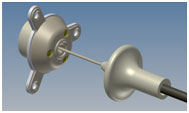
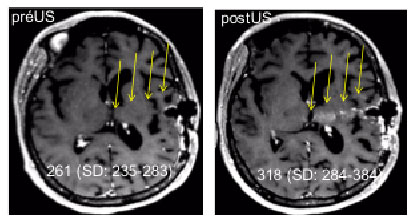
In a collaboration between Carthera, LabTAU and APHP, an implantable planar ultrasound transmitter was developed. It allows targeted and repeated openings (synchronized with the chemotherapy sessions) of the BBB in the periphery of the brain tumors while avoiding the skull bone, source of attenuation and diffraction of ultrasonic waves. A world premier was performed at the Hospital La Pitié Salpétrière in Paris in July 2014. The technique is safe and efficient. New developments aim at optimizing the technology.
Funding sources
LabTau Staff
- Alexandre Carpentier (PI)
- Cyril Lafon (PI)
- Jean Yves Chapelon (PI)
- Nicolas Asquier
Collaborations
- Carthéra (Lyon)
- APHP (Paris)
- Carpentier A, Canney M, Vignot A, Reina V, Beccaria K, Horodyckid C, Karachi C, Leclercq D, Lafon C, Chapelon JY, Capelle L, Cornu P, Sanson M, Hoang-Xuan K, Delattre JY, Idbaih A. Clinical trial of blood-brain barrier disruption by pulsed ultrasound.
- Horodyckid C, Canney M, Vignot A, Boisgard R, Drier A, Huberfeld G, François C, Prigent A, Santin MD, Adam C, Willer JC, Lafon C, Chapelon JY, Carpentier A. Safe long-term repeated disruption of the blood-brain barrier using an implantable ultrasound device: a multiparametric study in a primate model.
- Goldwirt L, Canney M, Horodyckid C, Poupon J, Mourah S, Vignot A, Chapelon JY, Carpentier A. Enhanced brain distribution of carboplatin in a primate model after blood-brain barrier disruption using an implantable ultrasound device.
- Beccaria K, Canney M, Goldwirt L, Fernandez C, Piquet J, Perier MC, Lafon C, Chapelon JY, Carpentier A. Ultrasound-induced opening of the blood-brain barrier to enhance temozolomide and irinotecan delivery: an experimental study in rabbits.
- Beccaria K, Canney M, Goldwirt L, Fernandez C, Adam C, Piquet J, Autret G, Clément O, Lafon C, Chapelon JY, Carpentier A. Opening of the blood-brain barrier with an unfocused ultrasound device in rabbits.